The debate over whole dip versus spray pre-treatment still keeps people awake. Not because it’s complicated, but because so many manufacturers are making the wrong choice for their specific needs.
Let me tell you what’s really happening in India’s manufacturing space right now. Surface preparation has become absolutely critical for product quality and how long your stuff actually lasts. Pre-treatment plants, especially the dip and spray systems, are basically the foundation of everything. With India’s coating pre-treatment market growing at about 6.4% CAGR (which is pretty solid, by the way), more manufacturers are finally waking up to this.
Why Pre-treatment Actually Matters
Here’s the thing: pre-treatment isn’t just some fancy extra step you can skip when budgets get tight. It’s literally the foundation of any decent coating job.
The process itself is pretty straightforward, but the devil’s in the details. You’ve got degreasing (getting rid of oils and nasty contaminants), alkaline cleaning for rust removal, rinsing to eliminate chemical leftovers, conversion coating for that protective layer, and passivation to seal everything up.
Well, it is, and it isn’t. What most people don’t realise is that thorough material pre-treatment is basically the fundamental prerequisite of any high-quality coating. The choice between wet and dry methods? That completely depends on what material you’re dealing with.
What is Dip Systems
So, dip pre-treatment plant, this is where you literally dunk your components into chemical baths. Complete submersion. Crescent Techno actually does this really well with their PLC-based transportation systems, or you can go old-school with electrically operated overhead hoists.
The beauty of dip systems doesn’t miss spots. Complex geometries, weird angles, hidden surfaces, everything gets the same treatment.
Spray systems just couldn’t reach everything consistently. But their dip system? Every single part came out perfectly treated. The process uses multiple tanks arranged like a production line.
Each tank has specific chemicals for different stages. You either move parts manually with hoists or use automated PLC-controlled transporters. The automatic PLC control really gives you superior consistency.
Where Dip Systems Really Shine
Dip systems work best for medium to higher capacities, especially for job coaters and automotive applications. If you’re dealing with irregularly shaped stuff, where spray might miss spots?
The advantages are pretty compelling: simple maintenance, lower capital costs, prolonged chemical contact time, complete solution contact, and flexible chemistry options. That extended contact time is huge for components that need deep cleaning or serious surface modification.
And let’s talk money for a second. Pricing ranges from about ₹2.5 lakhs to ₹35 lakhs, depending on what you need. That’s actually quite reasonable when you consider the consistency you get.
The Technical Side
Modern dip systems use some pretty sophisticated stuff. PLC-based transportation and electrically operated overhead hoists are standard now. Tank materials vary based on what chemicals you’re using, and could be polypropylene, mild steel with protective coatings, or stainless steel. The key is chemical compatibility.
Spray Systems
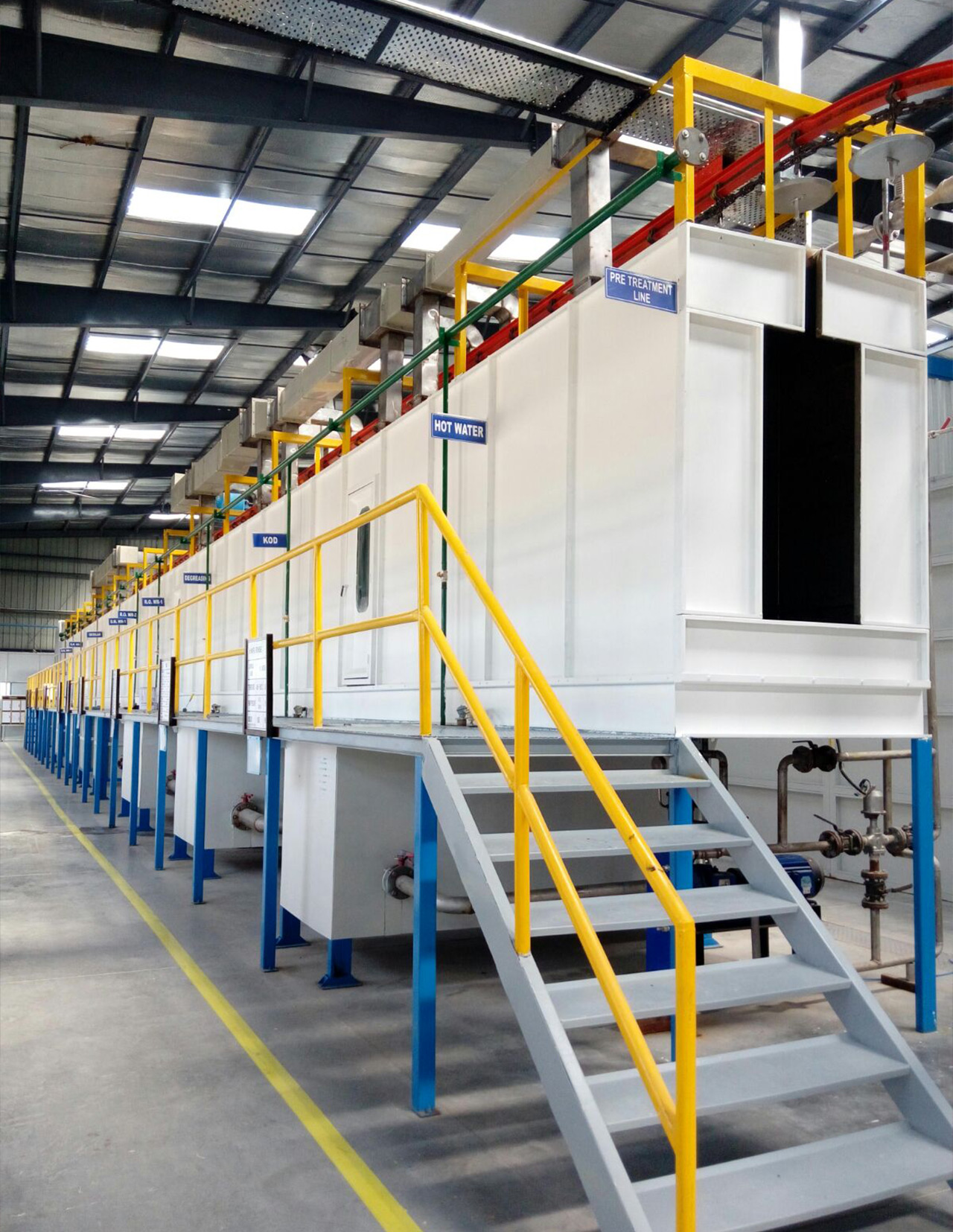
Now spray systems use high-pressure nozzles to basically blast chemical solutions onto your parts. It’s efficient for high-volume lines, and Crescent Techno Spray PT Lines are designed for large painting operations and automotive components. Fully automatic operation with excellent, uniform results.
The tunnel design is actually pretty clever. Multiple spray zones are arranged in sequence, each with its own chemical recipe. The funnel systems collect the sprayed chemicals and recirculate them back into tanks.
Nothing gets wasted, and you maintain consistent quality. High-pressure pumps and spray nozzles create an impact on the product to enhance cleaning. It’s all about that mechanical action combined with chemical treatment.
When Spray Makes Sense
Spray systems are mainly used for mass production with minimal manual intervention. Perfect for large painting lines and automotive components where you need consistent quality and high throughput.
The Indian market is showing solid growth here. Systems typically run ₹6.2 lakhs to ₹15 lakhs for standard setups. Spray pre-treatment plants are installed across leading OEMs in India, so the technology is proven.
Making the Right Choice
Low to medium volumes? Go dip for flexibility and thorough treatment. High-volume standardised production? Spray all the way. But here’s what really matters: think about growth. What will your production look like in three years?
Complex shapes and hard-to-reach areas? Standardised geometries and large flat surfaces? Spray excels. Material handling is important too; size, weight, and configuration all matter.
Dip systems often deliver better. Want consistency and automation? Spray systems with precise control. Quality specs should drive your decision, not just cost.
What’s Coming Next
The market is shifting toward non-chromate formulations as everyone moves to safer alternatives. Zirconium and titanium-based coatings are replacing traditional chromate. Better performance, less environmental impact.
Rising investments in vehicle assembly and appliance production are pushing demand. The market is particularly strong in two-wheelers and passenger cars. Government policies supporting manufacturing hubs and exports keep driving growth.
Conclusion
Choosing between dip and spray isn’t about which technology is “better”; it’s about which fits your specific situation. Dip gives superior quality for complex components and medium volumes. Spray delivers the best efficiency for high-volume industry production.
The manufacturing system in India is growing. The technologies are also an important part. So the long-lasting materials are the best for the environment. So choosing the right chemical-based solutions is important.